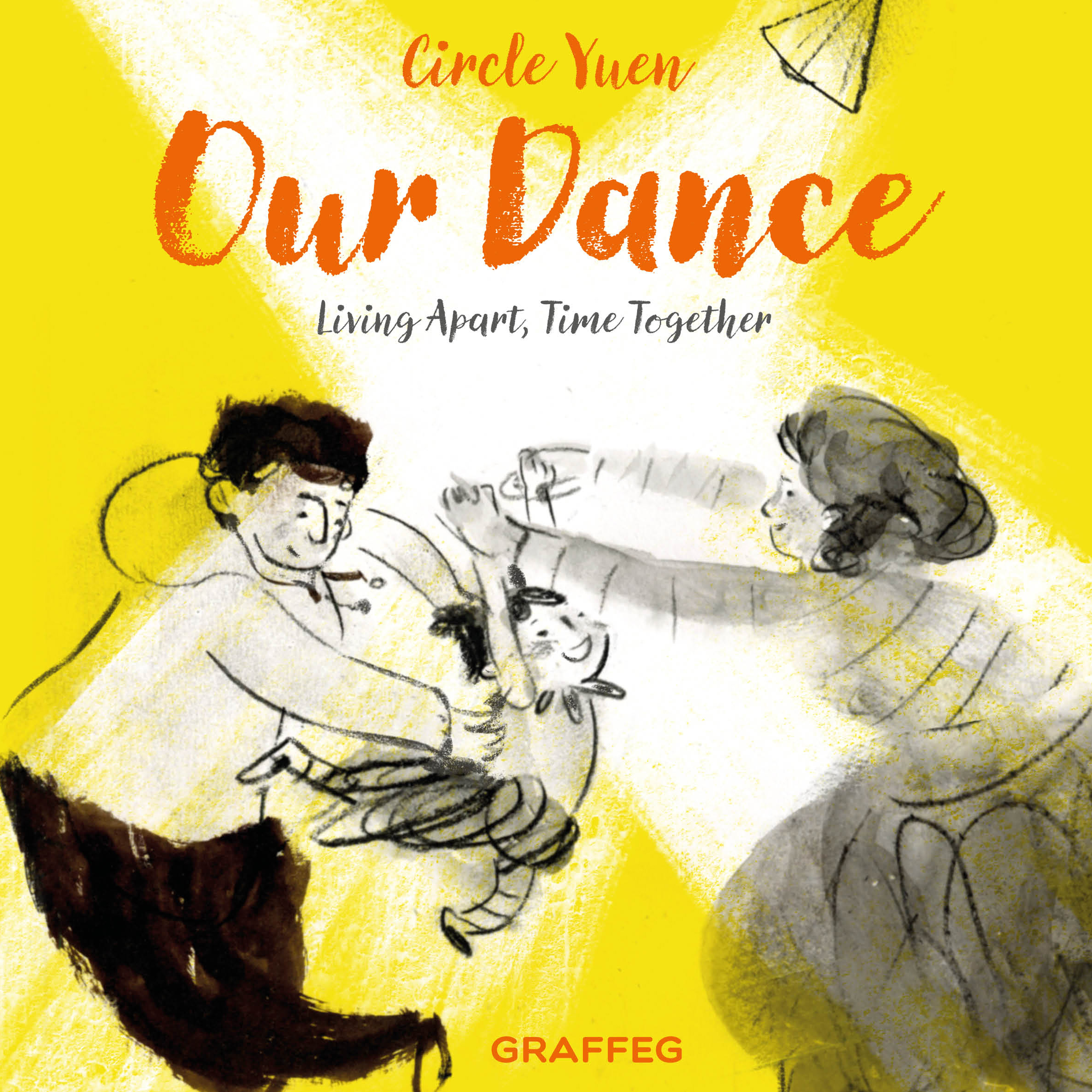
Our Dance, written and illustrated by Circle Yuen
Our Dance is one of six books on the shortlist for the 2026 Klaus Flugge Prize. The story of a little girl’s experiences when her parents separate, it is deeply affecting, and Circle Yuen’s illustrations have a rawness that makes them feel very immediated.
Former Klaus Flugge Prize judge, Senior Lecturer in Education: Primary English and Children's Literature, Oxford Brookes University, Mat Tobin interviewed Circle about her book.
Our Dance feels deeply personal. What inspired you to create this story?
Our Dance was built from a combination of social observation and personal experience, which makes the process quite different from illustrating someone else's story. The real work was not in researching my way closer to the material, but in finding a safe distance from it. That process still takes time to fully unpack, particularly as I move into two further books, Oakie (Graffeg, Oct 2026), written by Isla McGuckin, and Mama's Wedding (Lantana publishing, Sept 2026), which I have both written and illustrated myself.
I have chosen to answer some of your questions in more depth below, and I hope there will be another chance to share more.
A family is like a nest. When parents divorce, it is like the nest moving through a storm named separation. The core of co-parenting is not about two adults leaving the nest. It is about how to make sure the nestlings land safely. As we cannot control the storm, parents have the responsibility to minimise the risks and harm their children may have to bear.
Over one million children in the UK have no contact with a parent after separation. There are nearly 300 child contact centres across the country, yet many parents, and even professionals, don't know they exist (National Association of Child Contact Centres, 2021). I believe stories about divorce and shifting family structures matter not only for the children who read them, but for the adults who hand them over, a small part of that safe landing, because both are rarely given a story that names what they are feeling, gently and without alarm.
Knowing why it mattered was only the beginning. The harder question was how to tell it.
One of the most striking aspects of the book is its child narrator. How did you discover that voice?
For a long time, the story was told from a parent's point of view. One early draft opened with the line, ‘Co-parenting is like managing the most challenging group project.’ It was honest, but it kept the children absent, or passive, on the page.
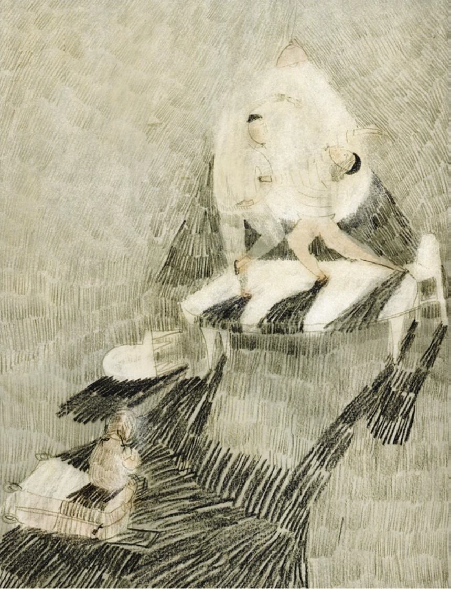
It was through guidance from Shelley Jackson, our Course Director at the Cambridge School of Art, that I recognised the importance of incorporating children's perspectives into my story. That shift proved to be the breakthrough. Once I moved from the parent's first-person narration into a child's, the story could finally speak the way children do, not by explaining what was happening around them, but by finding their own place to keep it safe. That is how the line arrived: ‘When nobody is watching, I hide Daddy under my pillow, and we dance all night long.’
The illustrations never show conflict directly, yet the emotional impact is incredibly powerful. How did you approach those visual decisions?
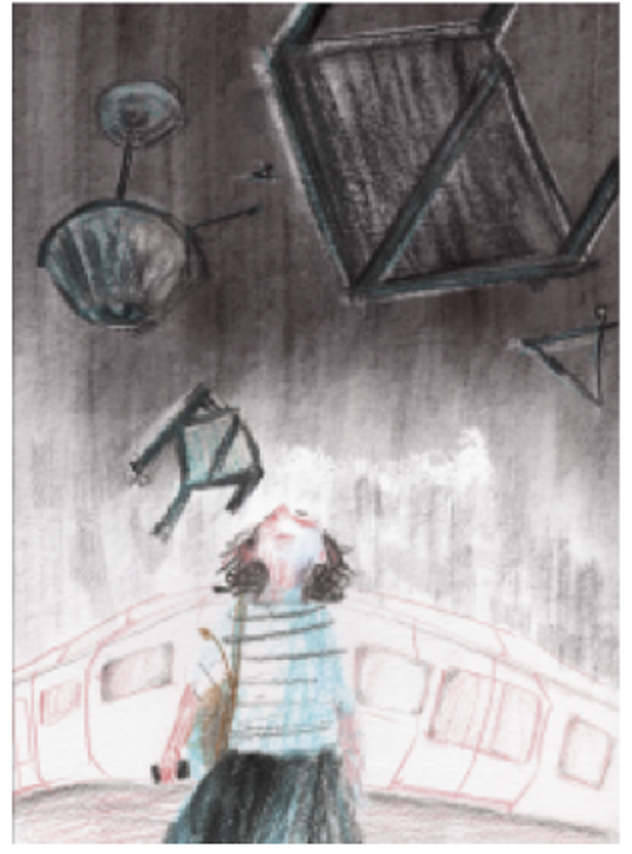
Once the child's voice was there, other choices followed. In one spread, we only see the lower half of the parents' moving bodies, while the child's narration says, ‘Then I heard their dancing that night but I don't want to see.’ A falling cup and clothes hangers on the floor suggest conflict, without ever showing it to the child, or to the reader. I also moved the narration into the past tense, which changed how the reader holds the girl's feelings, watching her come to terms with something already behind her, rather than living through it in real time. That gap between what is said and what is shown is what let the quiet, atmospheric voice of Our Dance take shape.
The voice was there. Finding somewhere for it to be published was another matter.
Publishing such an emotionally honest picturebook can't have been straightforward. How did Our Dance find its home?
After graduation, the rejections came steadily. The reason was almost always the same: too difficult, not enough market for it.
I remembered Only One of Me, a book I had studied during my MA for a research and review project. It began as a crowdfunded project by Lisa Wells, who wrote it while living with a terminal diagnosis, choosing to tell her daughters plainly that she would die rather than reach for the metaphors, ‘mummy becoming a star,’ that other books about loss often use. Graffeg had backed that directness fully, letting something so personal reach print without outside funding behind it.
That memory gave me somewhere to aim. I brought a dummy of Our Dance to Matthew, Graffeg's publishing director and my editor.
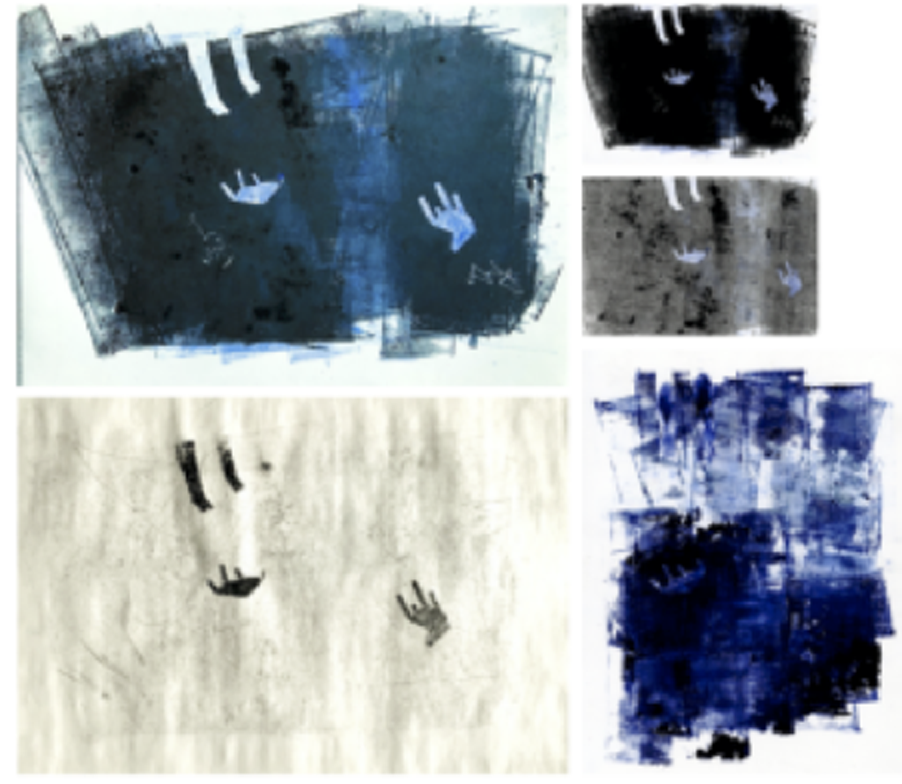
Later, when the artwork itself was in question, that belief was tested. Peter Gill, Chief Executive Officer at Graffeg, gave one direction: ‘Keep the black and yellow. Don't change it.’ He was asking for the most direct version, the one I had almost softened out of fear.
Having a publisher who trusted the honesty of the image was one kind of safety. The other kind had to be built into the story itself.
You write beautifully about making this book 'safe' for children. What does that mean to you?
Safety, for me, is not a matter of age alone. A child who has never experienced separation and a child sitting in a co-parenting centre waiting room are not the same reader, even if they are the same age. The second child does not need the story explained to them. They need it to stay beside them without asking anything in return.
That distinction shaped every choice I made in Our Dance. When my own daughter once looked up and asked, ‘Mummy, where is Daddy? I miss him so much,’ I had no language for her. What I found instead was Babette Cole's Two of Everything, and we read it again and again, not because it explained our situation, but because it stayed beside us within it. That was the moment I understood what a picture book could do. Not explain. Simply: stay.
So instead of narrating the separation itself, Our Dance holds it inside a single image: ‘When nobody is watching, I hide Daddy under my pillow, and we dance all night long.’ A child who has lived through a handover at a bus stop or a McDonald's car park will recognise exactly what that hiding place means. But missing someone, and waiting for someone you love, is a feeling every child already knows, whether it's a parent gone for the evening or a parent gone for good. That is what makes the book safe for all of them: it never asks a child to understand divorce. It only asks them to recognise a feeling they already carry.
What has it meant to see readers respond to Our Dance?
Our Dance came out in June, and that same month I took it to a summer craft fair. Honestly, I was so scared this book might not fit in a craft fair setting. But watching people hold the book and read through it, page by page, was incredibly moving.
A young father came over, read through the book, then simply closed it and walked away, eyes wet with tears. A little while later, he came back, took out his phone to show me a photo of his daughter's beautiful face, held the book close, and left.
‘I'll buy it. It's for my classroom's children,’ one person said. Another: ‘This book is so important; I will go back to my office and recommend that schools have it.’ I held back my tears to say thank you, only to cry under the fair table afterward. It was never about which art prints sold well.
It brought me back to a sunny day in Hong Kong, walking with a young mother in a support group who couldn't speak through her tears because she wasn't allowed to see her three-year-old daughter. I'm not a social worker, and I can't tell that story again and again, but in that moment, I knew why I create books: to offer a small light. You don't even need to open it; just knowing there's someone else in the dark going through a storm, and that we believe we can walk through it, is enough.
Finally, you’re already working on new books. What comes next for you?
Making the book from lived experience required distance, the kind you find by going down like a free-diver into memory, and coming back up with only what a child could hold in the dark. Without that distance, the story would be overwhelmed by what it carries. With it, something opens that doesn't need to be explained, only felt.
Our Dance is published by Graffeg, 978-1917467469, £12.99 hbk.
The Klaus Flugge Prize is funded personally by Klaus Flugge and run independently of Andersen Press.
Website maintenance & Copyright © 2026 Andersen Press. All Rights Reserved. Privacy & Cookie Policy.